Why 'Per-Resolution' AI Pricing Punishes Growing Startups
Why "Per-Resolution" AI Pricing Punishes Growing Startups
When AI chatbots first arrived in customer support, the pricing models were simple. You paid for a seat, or you paid for a tier of messages. But as AI models became more capable, the industry shifted toward "outcome-based" pricing. The most prominent example is Intercom's Fin AI, which charges $0.99 for every conversation it "resolves."
On the surface, paying only when the AI successfully helps a customer sounds like the ultimate alignment of incentives. You only pay for value delivered. But for growing startups and multi-site operators, this pricing model often turns into a predictable nightmare of escalating, uncontrollable costs.
Here is a breakdown of why per-resolution AI pricing is fundamentally flawed for early-stage companies, and why the market is shifting back toward transparent, flat-rate models.
The Illusion of the $0.99 Resolution
Intercom's pricing structure layers traditional per-seat licensing on top of usage-based AI fees. As of 2026, the Essential plan starts at $29 per seat per month on annual billing, or $39 per seat on monthly billing. The Advanced plan runs $85–$99 per seat, and the Expert tier reaches $132–$139 per seat. On top of those base costs, you pay $0.99 every time Fin AI registers an "outcome" or "resolution."
If your website gets low traffic, $1 per resolution feels negligible. But the math breaks down quickly as you grow. Consider a startup that scales its marketing and starts seeing 2,000 support or sales inquiries a month. If the AI handles half of those — 1,000 resolutions — your monthly AI bill is suddenly $990, on top of whatever you are already paying in seat licenses. If a viral post or a successful ad campaign spikes your traffic, your support bill spikes with it. You are effectively penalized for generating more conversations.
One founder on Reddit described exactly this dynamic: their Intercom bill shot up from $4,000 to $9,000 per month — a 120% increase — after enabling Fin AI, without seeing a proportional improvement in outcomes. For a startup watching every dollar of runway, that kind of billing surprise is not a minor inconvenience. It is a strategic risk.
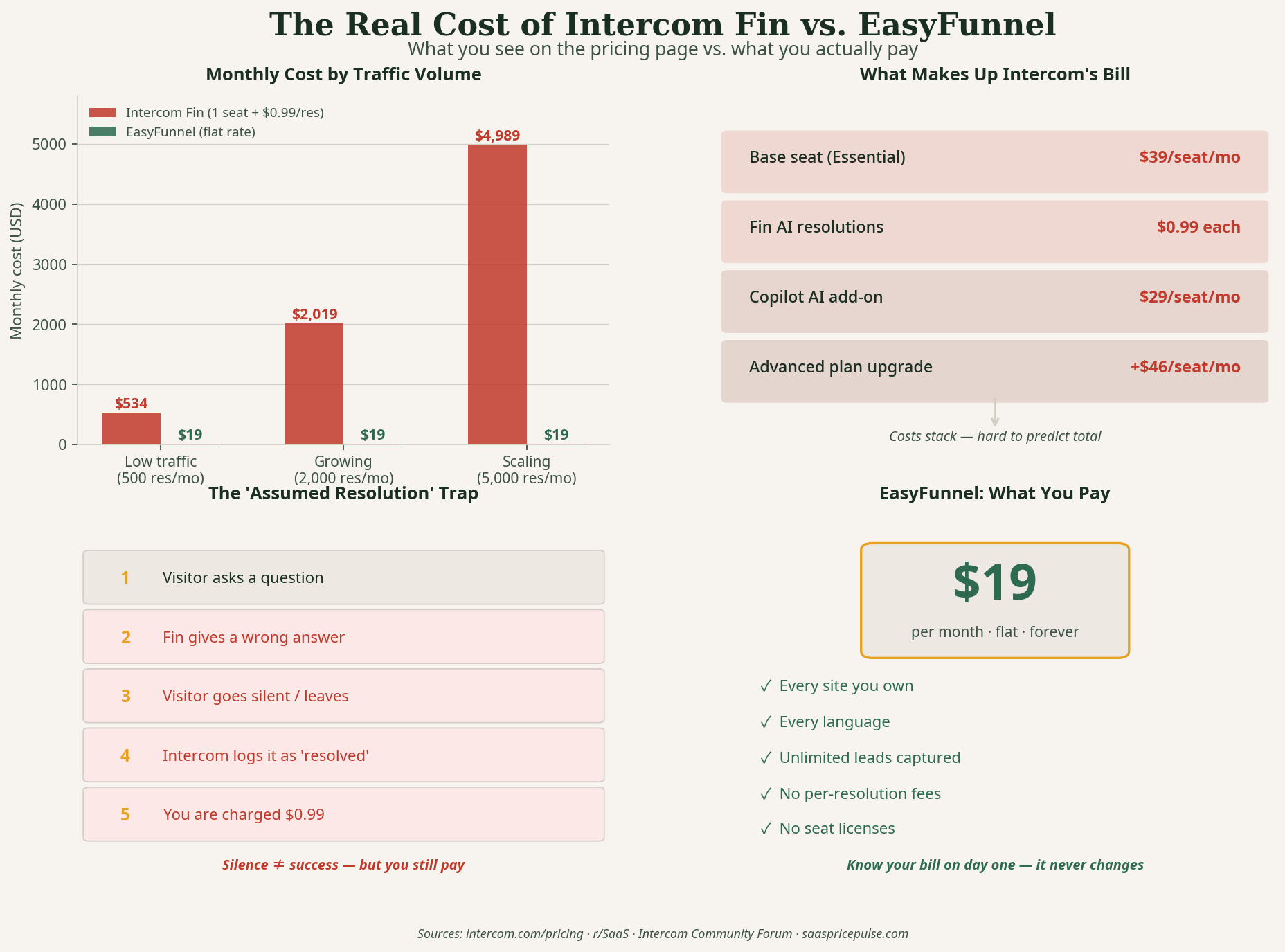
The infographic above shows the full cost picture: how Intercom's bill scales with traffic, how its billing layers stack, and how the "assumed resolution" mechanism charges you for conversations that were never actually resolved.
What Real Users Are Saying About Intercom's Pricing
The frustration is not isolated. An analysis of over 215 recent Intercom reviews on Capterra found a consistent pattern: users generally praise the quality of Fin AI itself, but the per-resolution billing model is described repeatedly as a "trap." The core complaint is not that the product does not work — it is that you cannot predict what it will cost you next month.
"Everyone raves about the Fin AI bot itself. It actually works. But that $0.99 per resolution pricing… oof. One review literally called it a trap because you basically can't predict your bill anymore. Founders hate surprise variable costs more than they hate bugs."
The sentiment is consistent across platforms. On Reddit's r/SaaS, threads about Intercom pricing regularly attract dozens of comments from founders describing bill shock, difficulty forecasting costs, and the feeling that the pricing model is designed to obscure the true cost until the invoice arrives. A separate thread from early 2026 put the scale problem bluntly: at $0.99 per resolution, a team handling 5,000 resolutions a month is paying $5,000 just for the AI layer, before accounting for seat costs.
Tired of unpredictable AI bills? Talk to the EasyFunnel agent — no account needed. See how it captures a lead in a real conversation, for a flat $19/mo.
The "Assumed Resolution" Problem: Paying for Outcomes That Never Happened
The deeper issue with outcome-based pricing is how a "resolution" is actually defined — and who controls that definition. Teams increasingly distrust AI metrics because the vendor billing you for outcomes is also the one deciding what counts as an outcome.
In Intercom's system, a resolution is not always a confirmed, explicit success. It often includes "assumed resolutions" — situations where the AI provides an answer and the customer simply stops replying or closes the chat window without clicking "That helped." The system infers success from silence.
A detailed thread in Intercom's own community forum illustrates how badly this can go wrong in practice. One user described running a SaaS platform for event venues where Fin would provide incorrect, multi-step troubleshooting answers to stressed customers dealing with live hardware failures. When the support team stepped in immediately to correct Fin's wrong answer, the system logged the interaction as an "assumed resolution" and charged $0.99 for it — even though Fin had given entirely wrong guidance and a human had to intervene to fix the problem.
"I now have to watch how a stressed out customer asks for technical help, get an incorrect answer, try all the incorrect steps, get more stressed and frustrated... and then after many minutes click the 'Speak to Human' button. After which I can step in and help them. It means I get: lower customer satisfaction, longer resolve times, incorrect Fin statistics, and more expensive invoices."
The user went further, noting that during a regional server outage — when every incoming message was clearly a systemic issue Fin could not solve — the system still expected customers to go through Fin's useless troubleshooting flow before a human could intervene, or the company would be billed $0.99 per conversation for the privilege of Fin failing to help.
The fundamental design problem is that Intercom's billing model creates a structural tension: the vendor is financially incentivized to classify as many interactions as possible as resolved, while the customer is financially penalized every time that classification is wrong.
The Hidden Costs Beyond the Per-Resolution Fee
Even setting aside the assumed-resolution problem, the true cost of Intercom is harder to calculate than the pricing page suggests. The per-seat base cost, the per-resolution AI fee, and the add-on costs for features like Copilot AI combine into a bill that is genuinely difficult to forecast.
Independent analyses of Intercom's 2026 pricing estimate that the average SMB pays approximately $37,354 per year, while enterprise customers average $72,174 per year. These are not numbers that appear anywhere on the pricing page. They emerge from the combination of seat tiers, AI usage, and add-ons that accumulate over time.
For a startup evaluating whether to use Intercom, this creates a fundamental due diligence problem. You can calculate your seat cost easily enough. But your AI cost depends on your conversation volume, your resolution rate, and how Intercom's system classifies each interaction — all of which are difficult to predict before you have months of data. By the time you understand your true cost, you are already locked in.
Want to see the full side-by-side comparison? Read the Intercom alternative breakdown or use the free conversion rate calculator to estimate how many leads you are currently losing.
Why Startups Are Moving Toward Flat-Rate Models
The backlash against unpredictable AI billing is driving a clear shift in how founders evaluate chat tools. The question is no longer just "does this AI work?" It is "can I trust this bill at the end of the month?"
Founders and operators are realizing that they do not need complex, enterprise-grade helpdesks with convoluted pricing matrices. For most early-stage companies, the primary goal of a chat widget is not to deflect support tickets away from a massive call center. The goal is to capture leads. They need an agent that can talk to visitors in their own language, answer basic questions, and capture an email or phone number before the visitor leaves.
That use case does not require per-resolution billing, seat licenses, or add-on AI tiers. It requires a predictable, flat-rate tool that does one thing well and tells you exactly what it will cost every month.
The $19/Month Predictable Alternative
This exact frustration is why we built EasyFunnel. We believe that an AI sales rep should be a fixed, predictable utility — not a variable tax on your website traffic.
EasyFunnel provides an AI sales rep that lives on every site you own. It talks to your visitors in their native language and captures the exact details you configure — whether that is an email, a phone number, or a WhatsApp contact. The moment a lead lands, it pings your inbox directly.
There are no per-resolution fees, no seat licenses to manage, and no surprise bills when your traffic spikes. It is a flat $19/month for every site, every language, and every lead. You know what you will pay on day one, and that number does not change based on how many conversations your AI has.
If you are tired of trying to forecast your monthly Intercom bill, or if you just want an AI agent that focuses on capturing leads rather than generating billing events, it takes 60 seconds to put EasyFunnel on your site.
Talk to the live agent — no account needed
Further reading: How conversational lead capture works · Multilingual AI chat for international visitors · Cheap Intercom alternatives for startups
Ready to track your funnels?
EasyFunnel gives you funnel analytics + an AI agent that captures leads. Try the live demo.
Talk to the agent